The Guide

How to use
Slow Calendar

Not a manual. More of an essay — the mental models behind each part of the product, and why they're built the way they are.

First things first

Install it like an app

Slow Calendar isn't in the App Store or Play Store — it's a web app you add straight from your browser. Once installed it lives on your home screen like any app, opens full-screen, and can send you gentle push reminders.

iPhone · Safari

Tap Share, then “Add to Home Screen”.

Android · Chrome

Tap ⋮, then “Install app”.

Desktop · Chrome / Edge

Click the install icon in the address bar.

On iPhone, push reminders only work once it's on your home screen — that's an Apple rule for web apps, not a Slow Calendar limitation.

The framework

I-ARC

Slow Calendar is built around a four-step cycle: Intent, Act, Reflect, Calibrate. It is not a productivity system. It is a practice of closing the loop between who you say you want to be and how you actually live.

Most people have good values and poor systems. I-ARC is the system.

IIntent

Begin with a north star. Not a task with a deadline — a direction. What kind of person do you want to be this year?

AAct

One concrete movement toward your intention each week. Not a project plan. One thing — a conversation, a morning, a moment created.

RReflect

At the end of each day, look honestly at what happened. Not to judge — to see. Reflection is not self-criticism. It is self-knowledge.

CCalibrate

What you learn from reflection changes what you do next. The path changes. The direction holds. Refine the pursuit, not the intention.

Intent — the north star, not the task list

An intention is a direction, not a destination. "Be more present with my kids" is an intention. "Attend every school play" is an action inside that intention. The distinction matters because the intention holds steady even when specific actions shift.

Act — one concrete movement per week

The Act step is not about having a full plan. It is about identifying one concrete thing this week that moves you toward your intention — a conversation you've been postponing, a morning you've been meaning to protect, a trip you keep deferring.

Reflect — an honest audit, not a judgement

The daily journal is the Reflect step in practice. Its purpose is not to record what happened. It is to see clearly what actually happened — the difference between the life you intended and the life you lived. That gap is information, not failure.

Calibrate — adjust the pursuit, not the intention

Calibration is what separates growth from repetition. When reflection shows you a recurring gap — you keep postponing time with your parents, you keep skipping the deep work block — you don't abandon the intention. You change the approach. The direction holds. The path changes.

Year Circle

What an intention is — and isn't

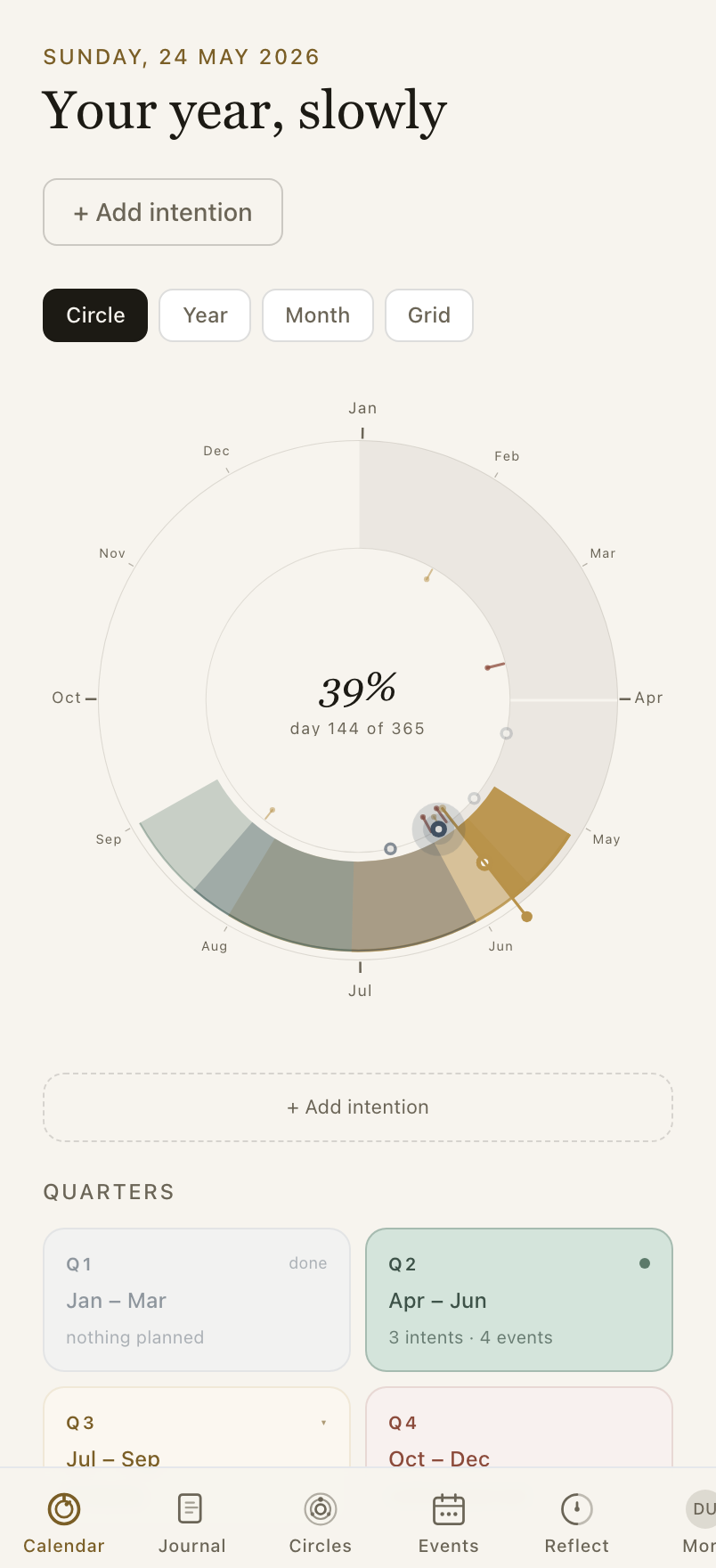
Intentions live on the Year Circle. They are the arcs that span your year — the sustained commitments that give shape to the months, not just the weeks.

The Year Circle — intentions as arcs, events and birthdays as ticks.

An intention is a claim you make on your own time before the world makes one for you.

Three ways to see the year

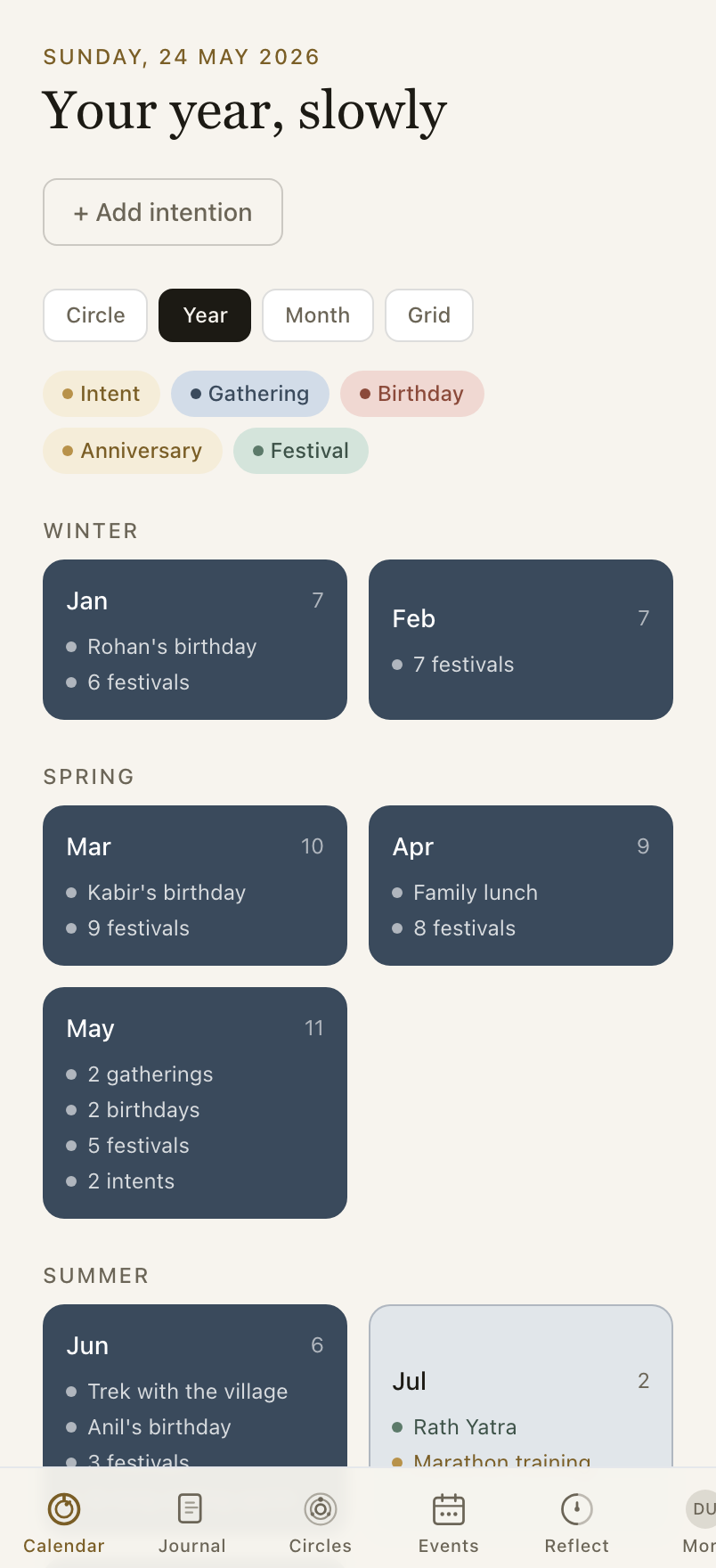
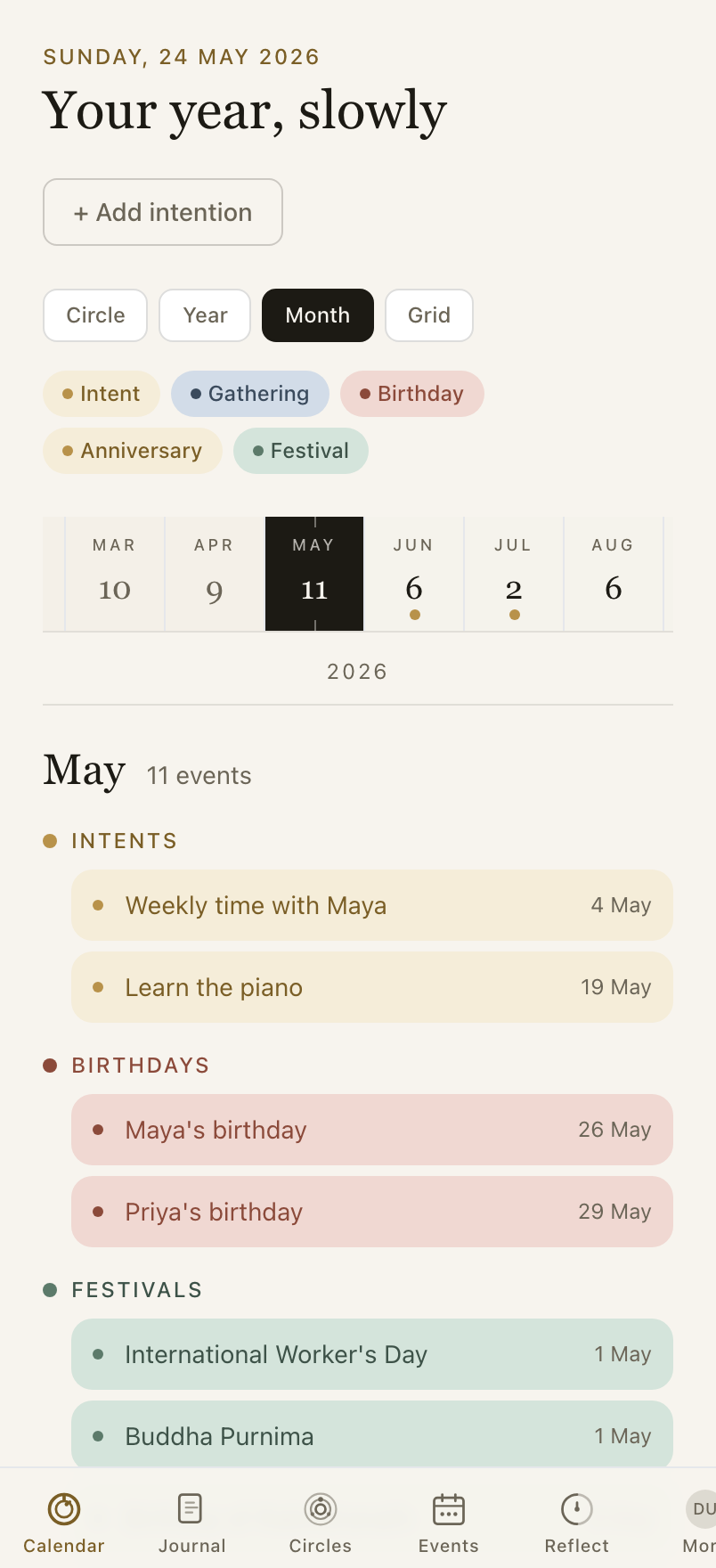
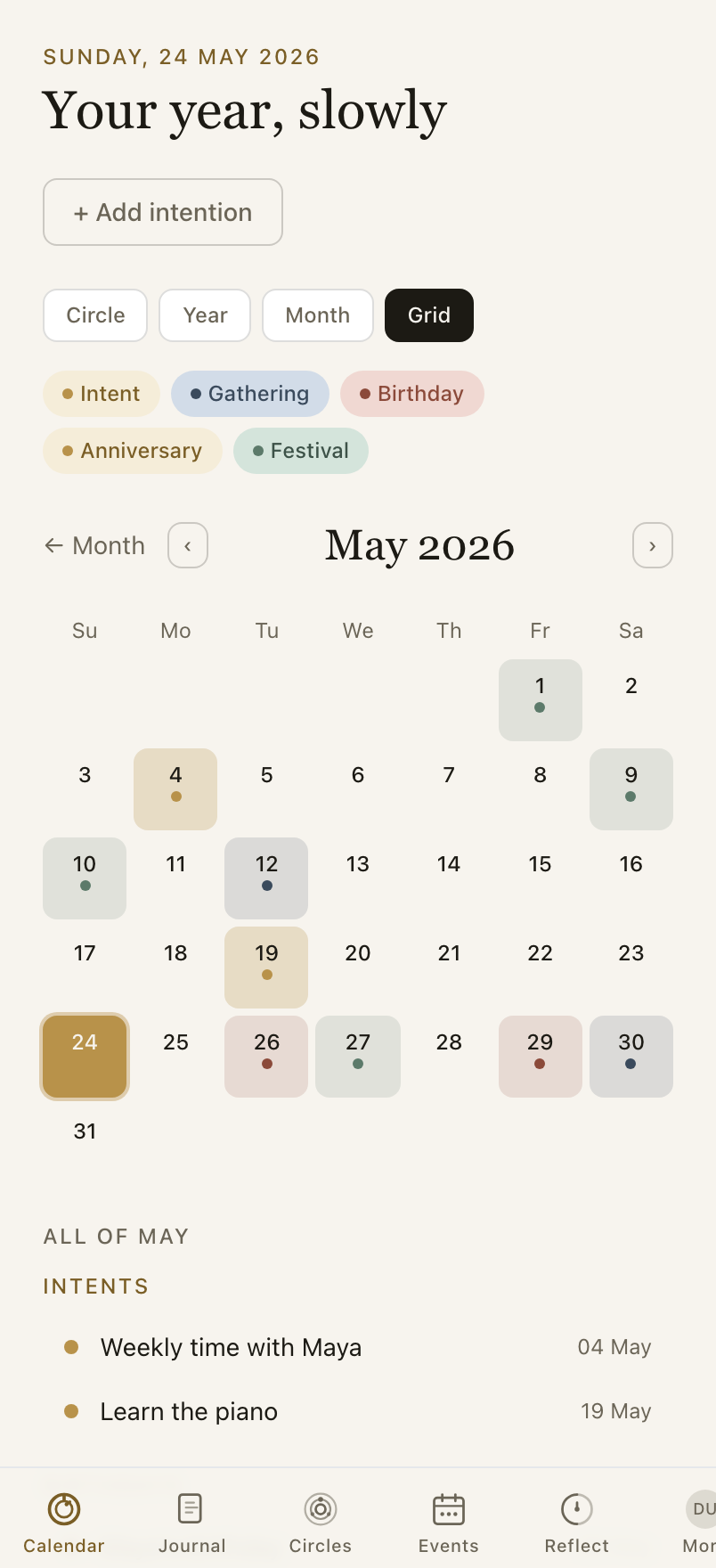
The same year, four lenses. The circle for the felt shape of the year; Year, Month and Grid for when you need the dates. Indian festivals are marked throughout.

Year — every month at a glance.
Month — the weeks up close.
Grid — a dense, scannable list.

Adding an intention

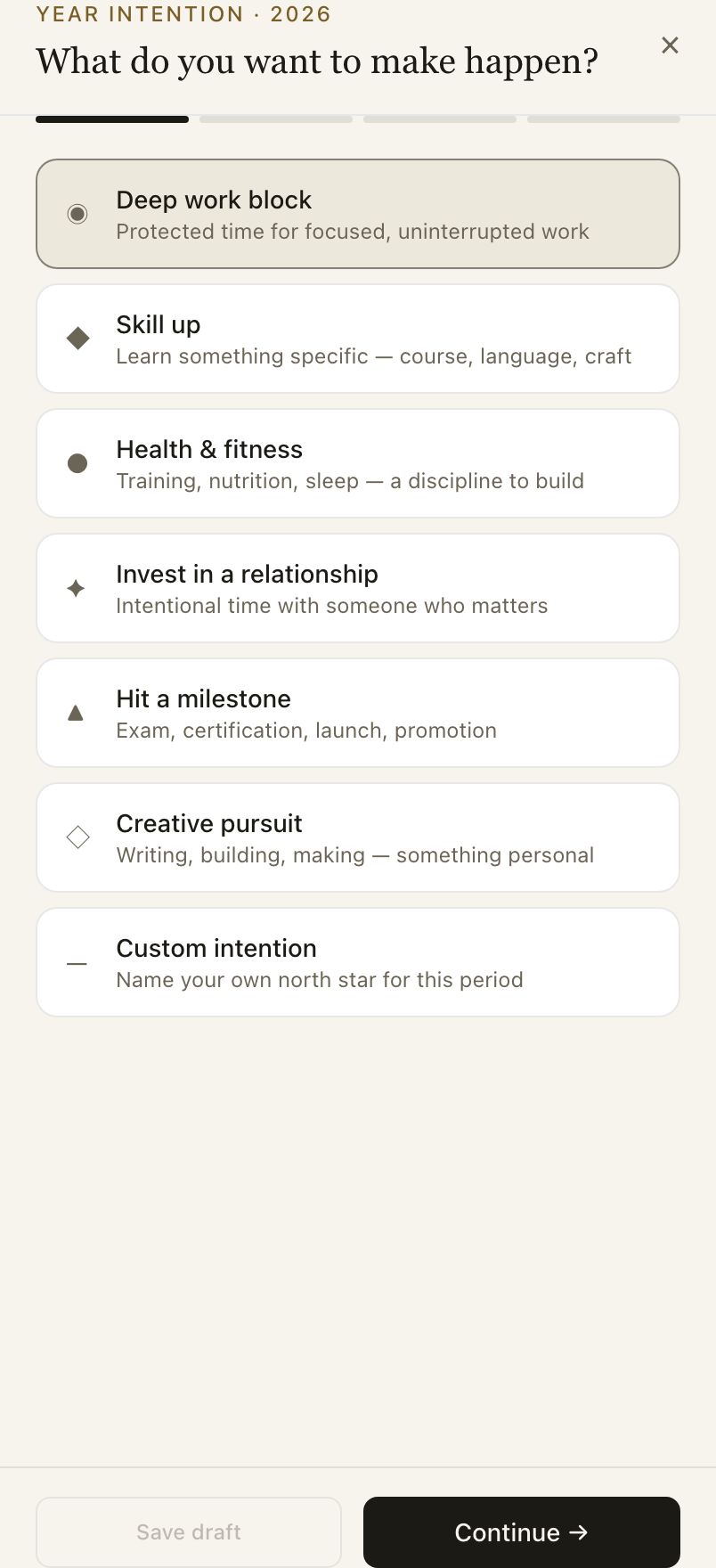
Name the direction, choose a type, and let it span the months it needs. It draws as an arc on the circle — a visible claim on the year.

Adding an intention to the year.

Intentions vs. goals

A goal is an outcome you hit or miss. An intention is a direction you either honour or drift from. The difference is that intentions survive failure. Missing a gym session doesn't break a health intention — it informs your calibration. Missing a quarterly revenue target might break a goal.

Intentions vs. events

Intentions are sustained — they span weeks or months. Events are discrete — they occupy a day or a weekend. "Being more present with family" is an intention. "Christmas in Coorg with the kids" is an event inside that intention.

How many intentions

Two to four per year. More than that and the circle becomes noise. The constraint is deliberate. If everything is an intention, nothing is. Choosing three means accepting that you are not choosing twenty other things — and that is the point.

People

Four circles. Why not one list.

Not everyone in your life deserves the same quality of your time and attention. This is not a cruel observation — it is an honest one. Treating everyone equally is how you end up being truly present for no one.

The circles are not a ranking. They are a map of how much presence each relationship needs.

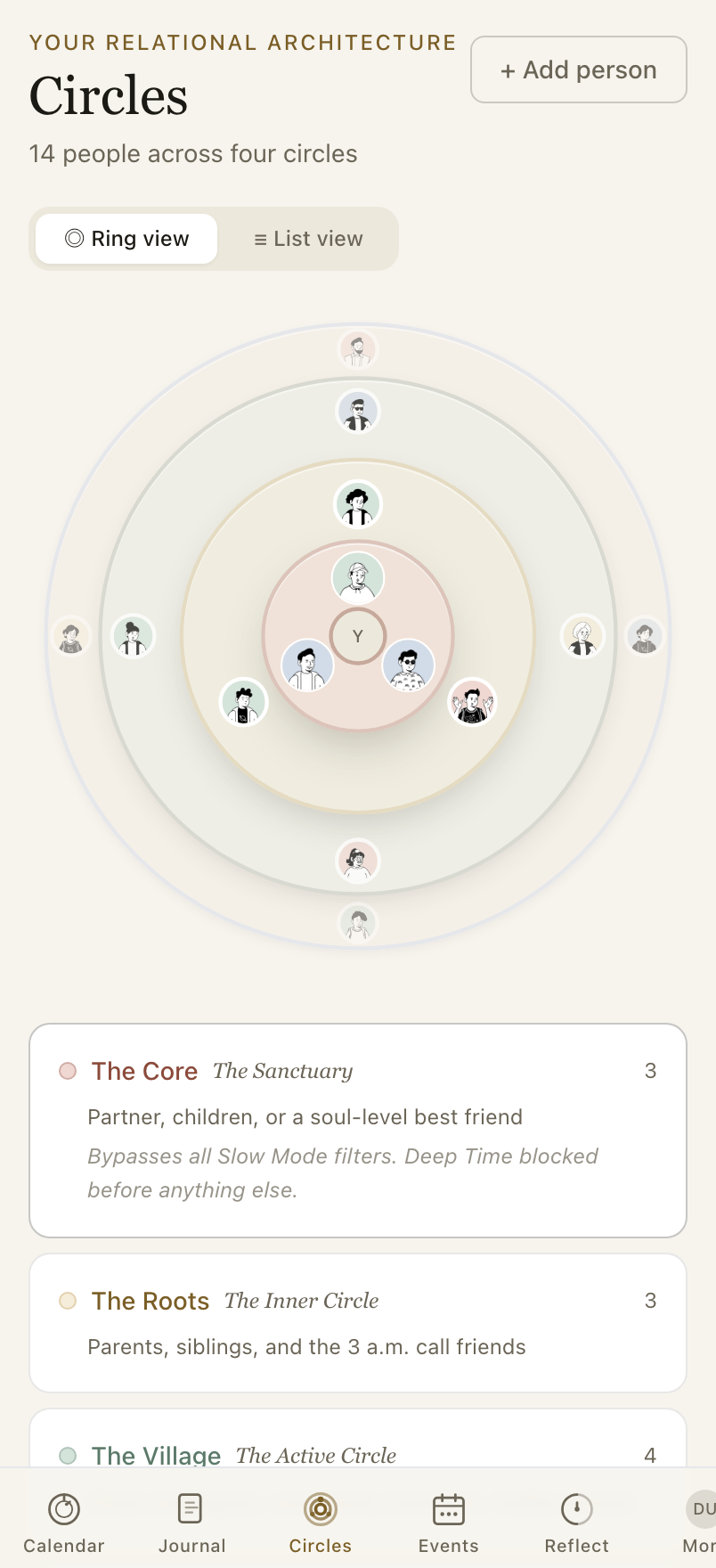
The rings — Core at the centre, Horizon at the edge.
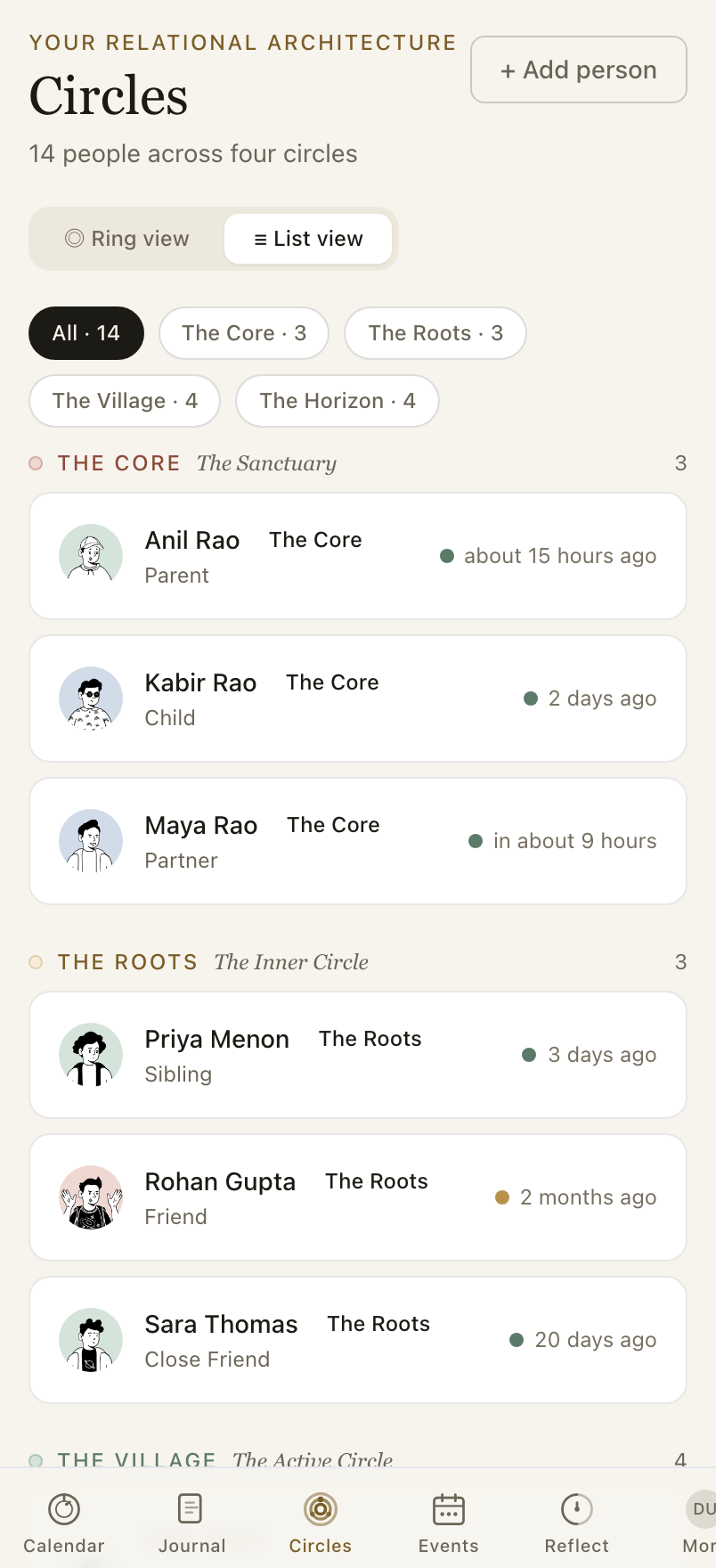
List view — everyone, by circle.
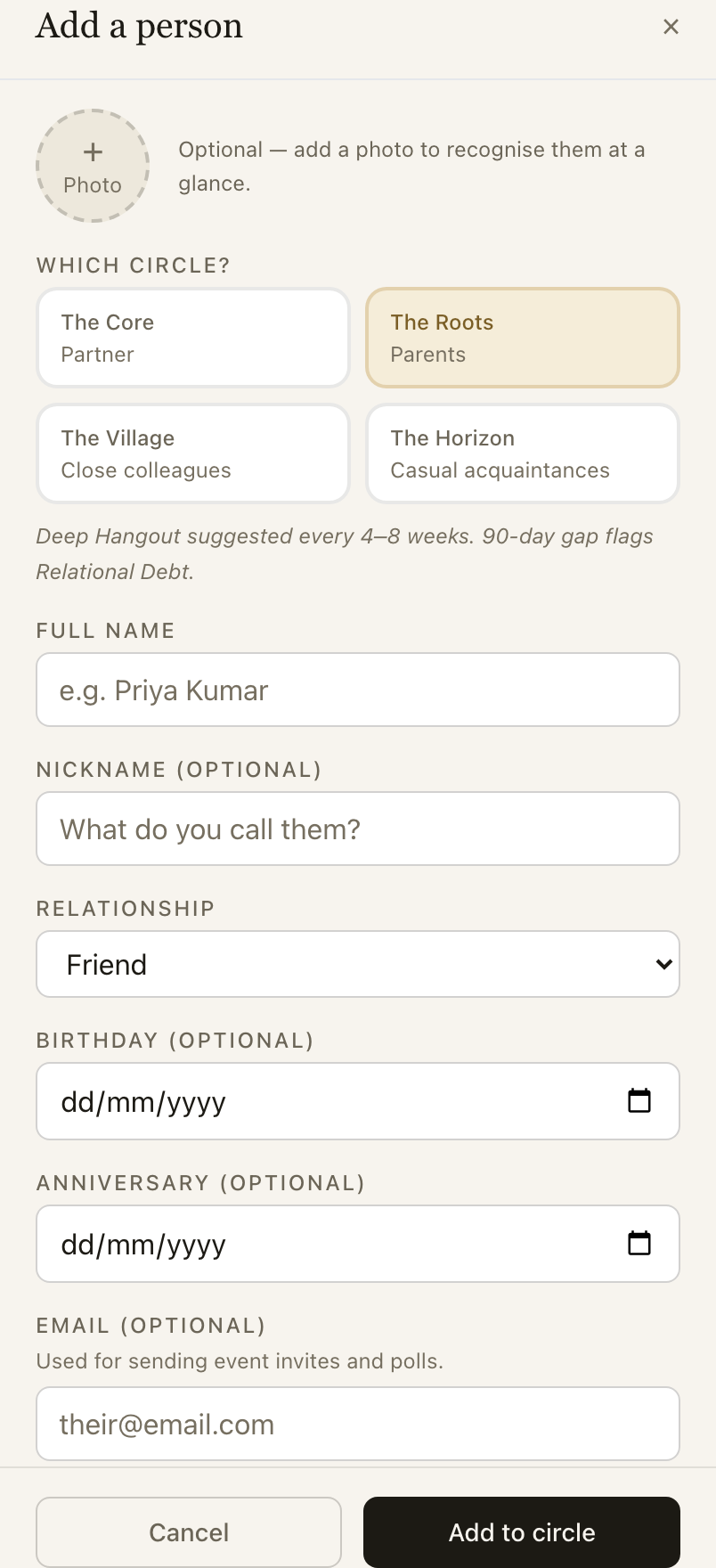
Adding a person to a circle.

Core — The Sanctuary

Two to four people whose absence from your year would genuinely damage you. A partner. A child. A friend you've had for twenty years. These are the relationships that need regular, protected, unhurried time — not just a birthday message.

Roots — The Inner Circle

Parents, siblings, the friends you'd call at 3am. These are the people who shaped you or who hold your history. They tolerate longer gaps — but those gaps still have limits. The relational clock ticks. Check in before you're overdue.

Village — Active Circle

Colleagues, teammates, community. These are relationships that thrive on shared context — the project, the neighbourhood, the hobby. They require less protected time but benefit from occasional investment beyond the transactional.

Horizon — Outer Circle

Acquaintances and loose connections. The value here is serendipity, not depth. Keep them warm; don't manage them like the Core.

The relational debt signal

Each person has a cadence — a rhythm of contact that keeps the relationship alive. When you go past that cadence, Slow Calendar flags it. Not as a guilt trip — as a reminder that you said this person matters, and your behaviour is starting to contradict that.

Events

Making gatherings real, not aspirational

Most important gatherings don't fail because of bad intent. They fail because they lived in a vague future — "we should do this sometime" — and never got pinned to a specific date.

An aspiration is not a plan. A date is a plan.

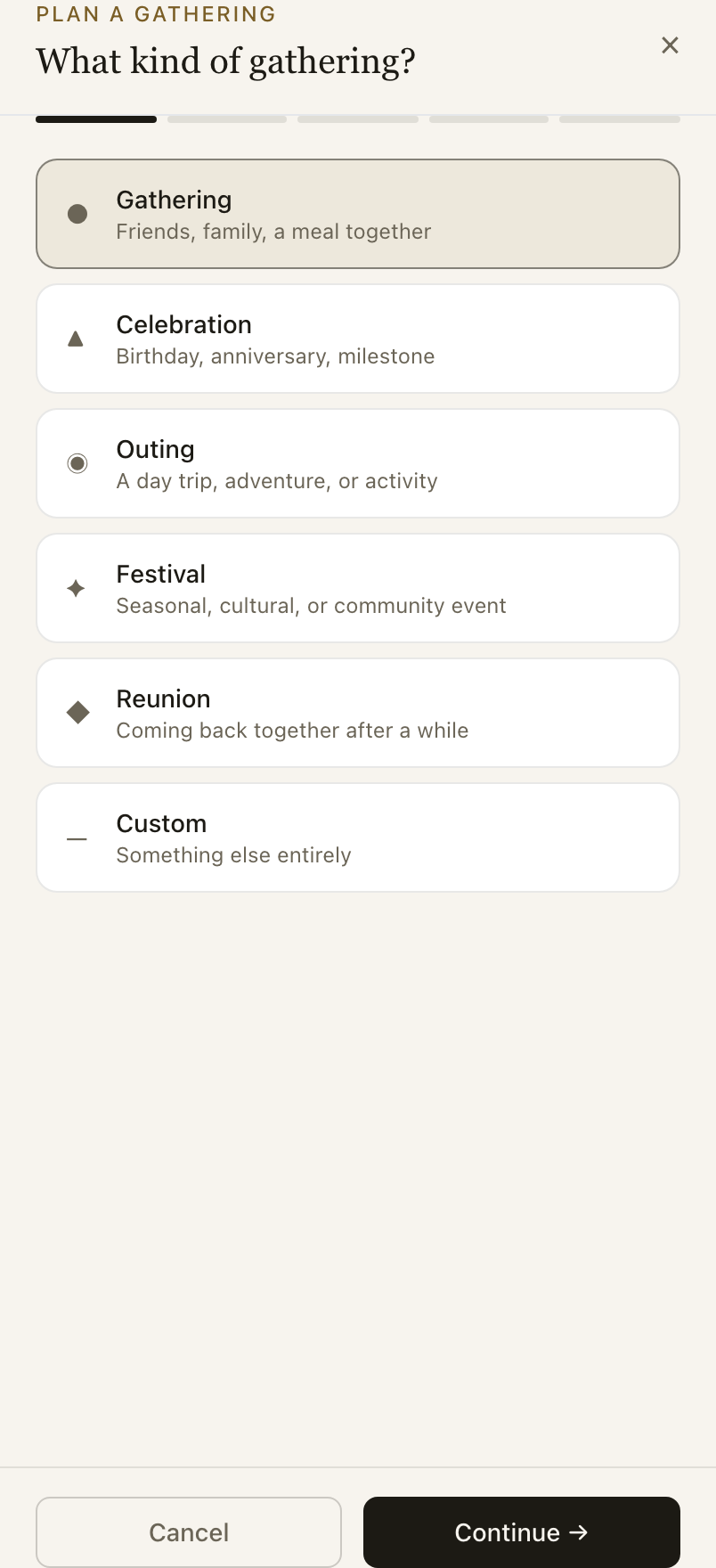
The Events tab is where you convert aspiration into commitment. Draft an idea. Run a poll if the date is uncertain. Confirm it when it's locked. The status trail — Draft → In Poll → Confirmed — turns "sometime" into a day on the ring.

Planning a gathering — pin a date, or open a poll.

Events vs. intentions

An event is a discrete gathering: a birthday dinner, a hiking weekend, a monthly call that became a ritual. An intention is the sustained direction those events serve. "Rebuild closeness with my siblings" is an intention. "Long weekend in Kodaikanal, August" is the event that makes the intention real.

Inviting others

When you add an event, you can invite the people in your circles — they receive a link and can respond without needing an account. This keeps the coordination lightweight without losing the confirmation that something is actually happening.

Journal

An audit, not a diary

The journal has a specific function: to make the gap between your intentions and your actions visible, every day, before the gap becomes a year.

You are not writing for posterity. You are writing for tomorrow's version of yourself.

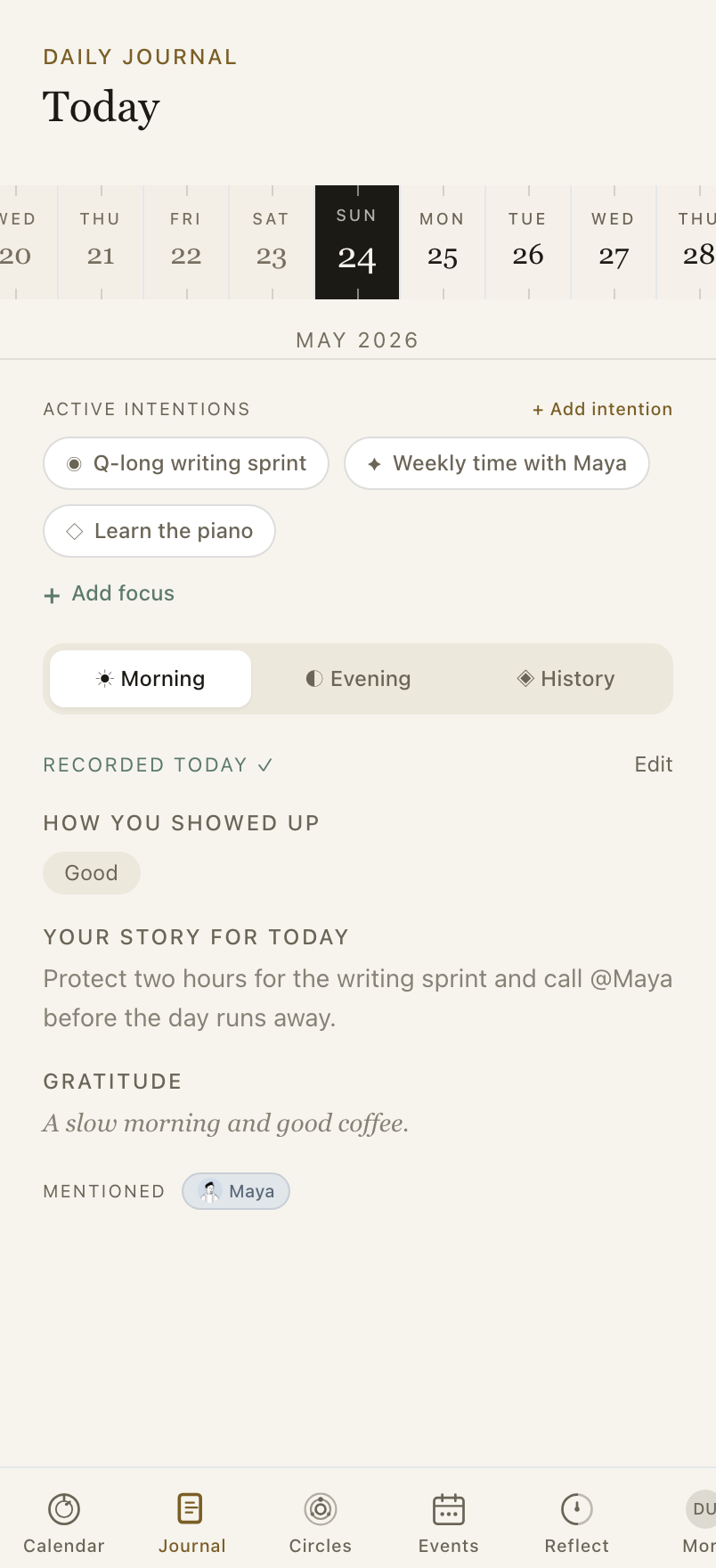
Morning — prime intent, virtue, and a gratitude.
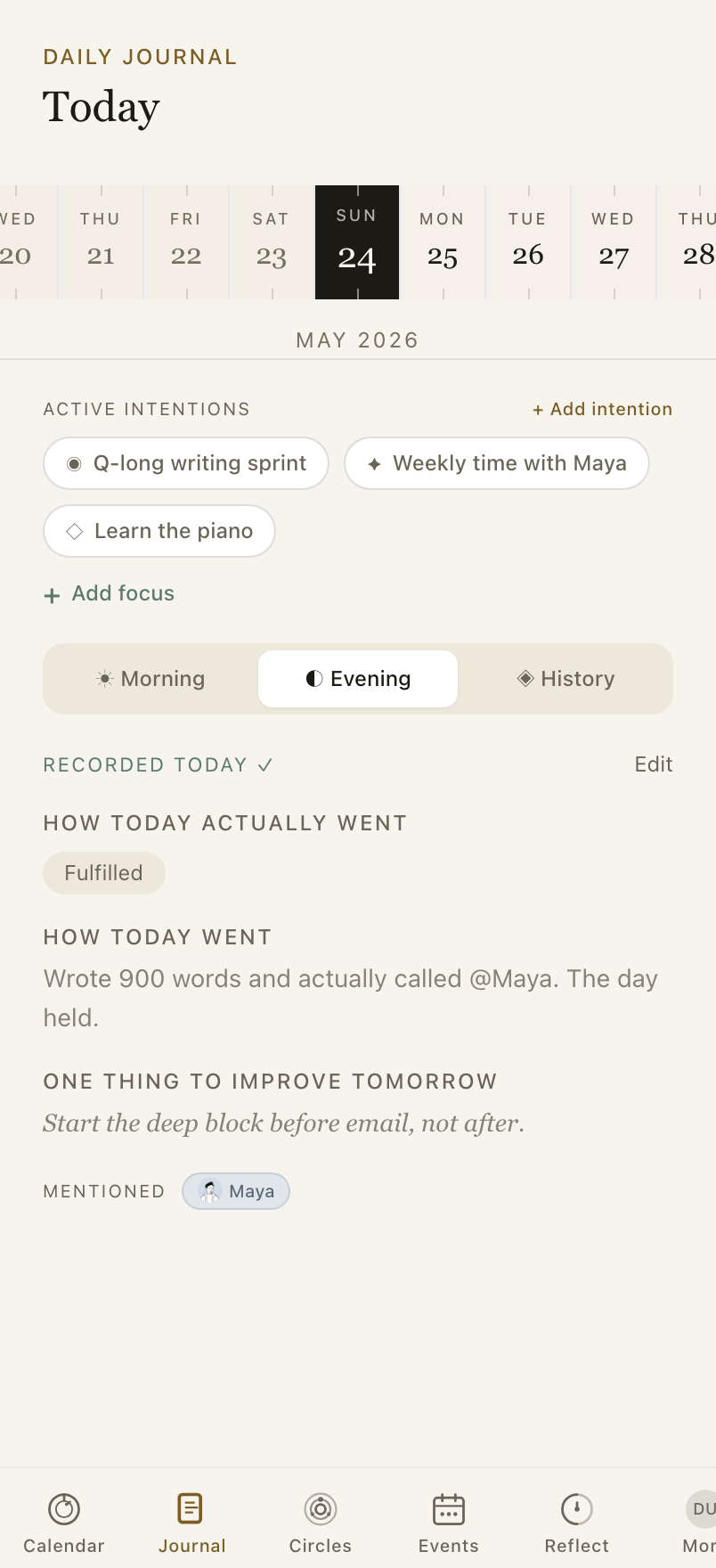
Evening — the honest review. Tag the people who shaped the day with @.

Morning — intent before input

The morning entry sets the prime intent for the day: the single thing that, if done, makes the day a success. This is not a to-do list. It is a commitment. One thing. It can be a task. It can be a conversation. It can be a way of being — patient, focused, present.

The virtue of the day comes from Stoic practice: a quality you want to embody today, not just accomplish. Wisdom, Justice, Courage, Temperance — not abstract ideals but lenses that change how you navigate the day.

Evening — honest review

The evening entry is the most important part. It asks one question: where did I fall short, and what will I do differently? Not "what did I achieve." Not "how did I feel." Where did I fall short. This is the Reflect step. It is not self-punishment. It is self-knowledge.

The people you tag are the ones whose presence shaped the day. Over time, this builds a picture of whose influence is consistent — and whose is absent.

Reflect — patterns over time

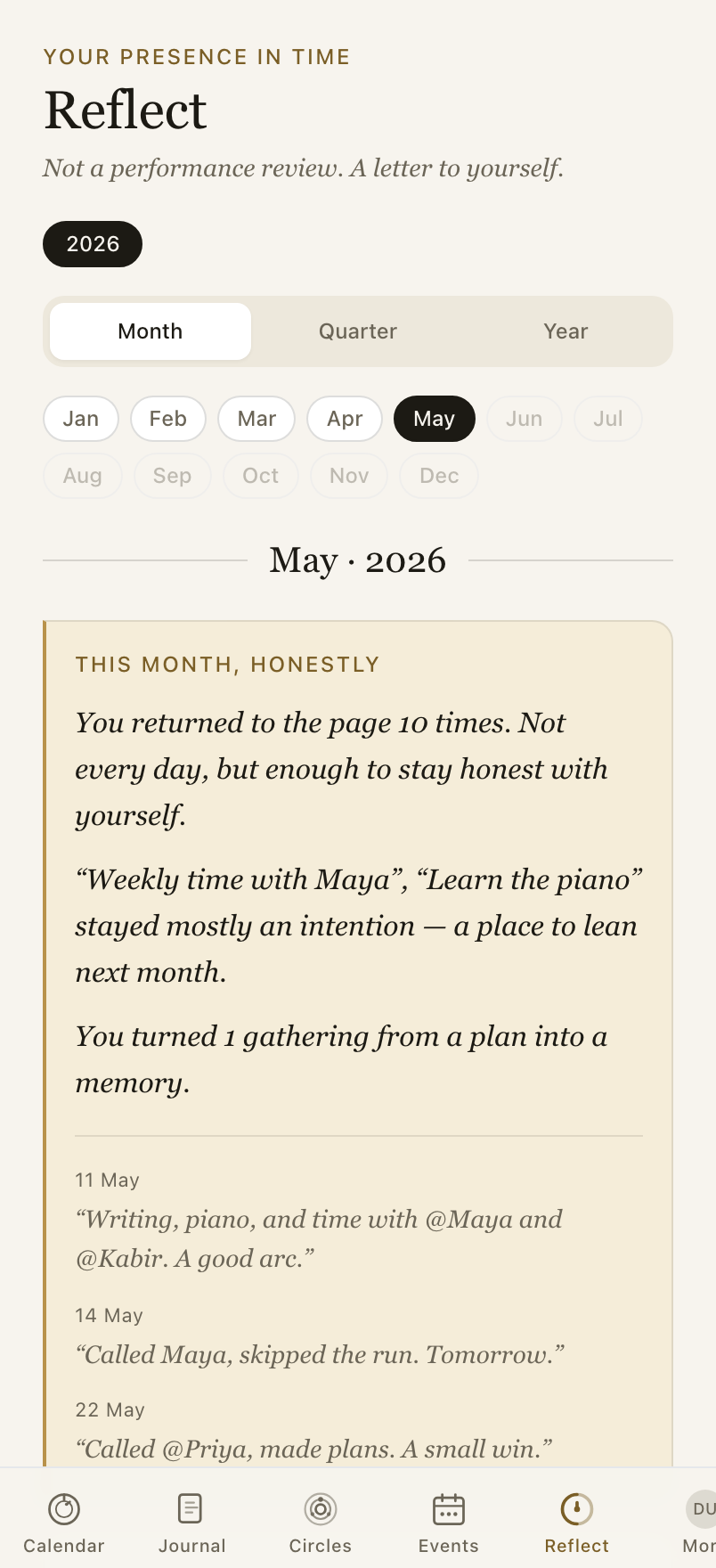
The Reflect page steps back from any single day. Choose a month, quarter, or year and it reads it back to you like a letter — an honest look at how you actually spent it, the intentions you lived and the ones that stayed quiet, the moments you made real, who the time held, and a single thing to carry forward.

Reflect — step back over a month, quarter, or year.

Journal

Focus and the daily intention

Each morning you can set a Focus — a single word or phrase that names the quality or mode you want to embody today. Focus is distinct from your prime intent (what you'll do) and your virtue (who you want to be). Focus is how.

"Deep work" is a focus. "Patient" is a focus. "Present" is a focus. It sits at the top of the journal as a constant reference point through the day.

A day with a named focus is harder to lose than a day without one.

Settings

Make it yours

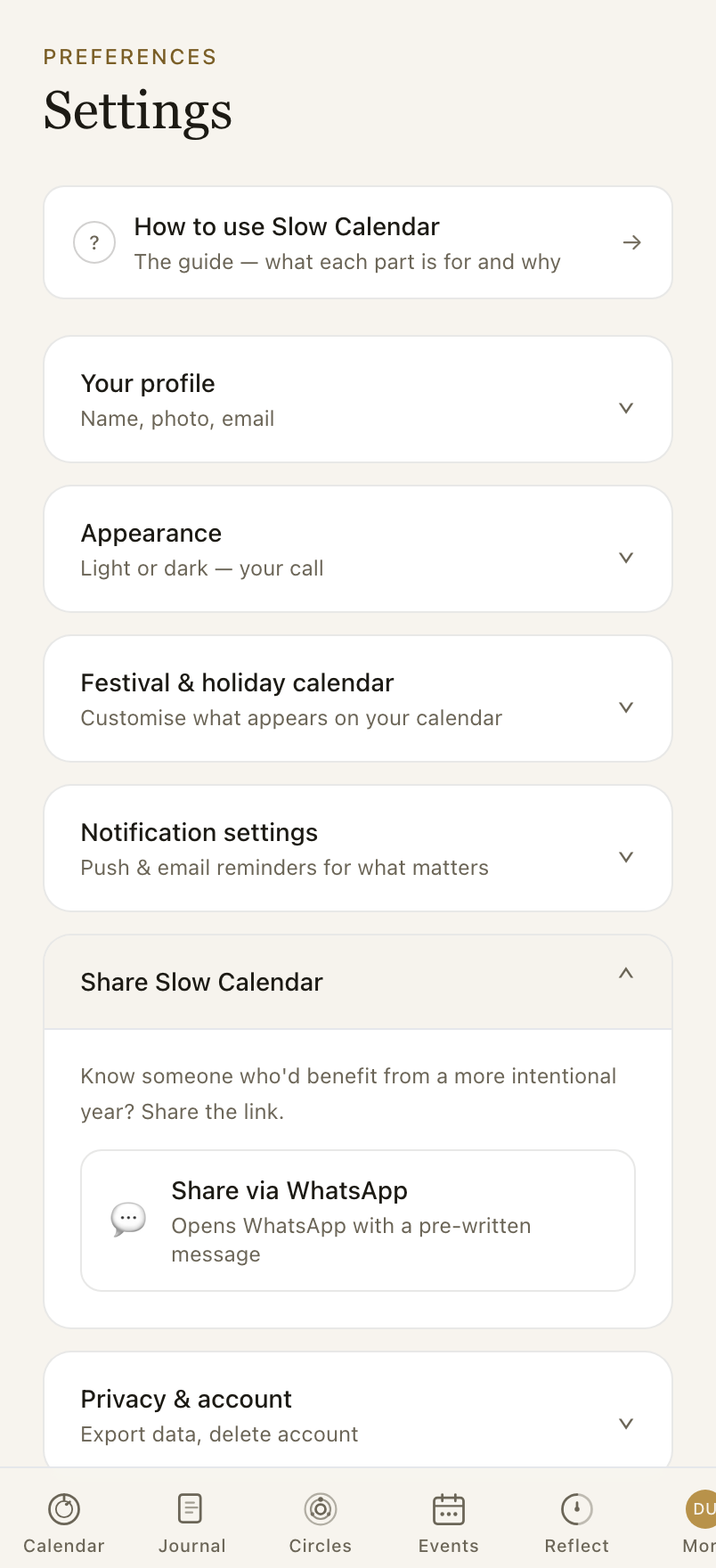
A few preferences let you shape Slow Calendar to your life — which holidays appear, what reminders you get, how it looks, and how you pass it on. Everything lives under Settings, each panel tucked away until you need it.

Choose your holidays

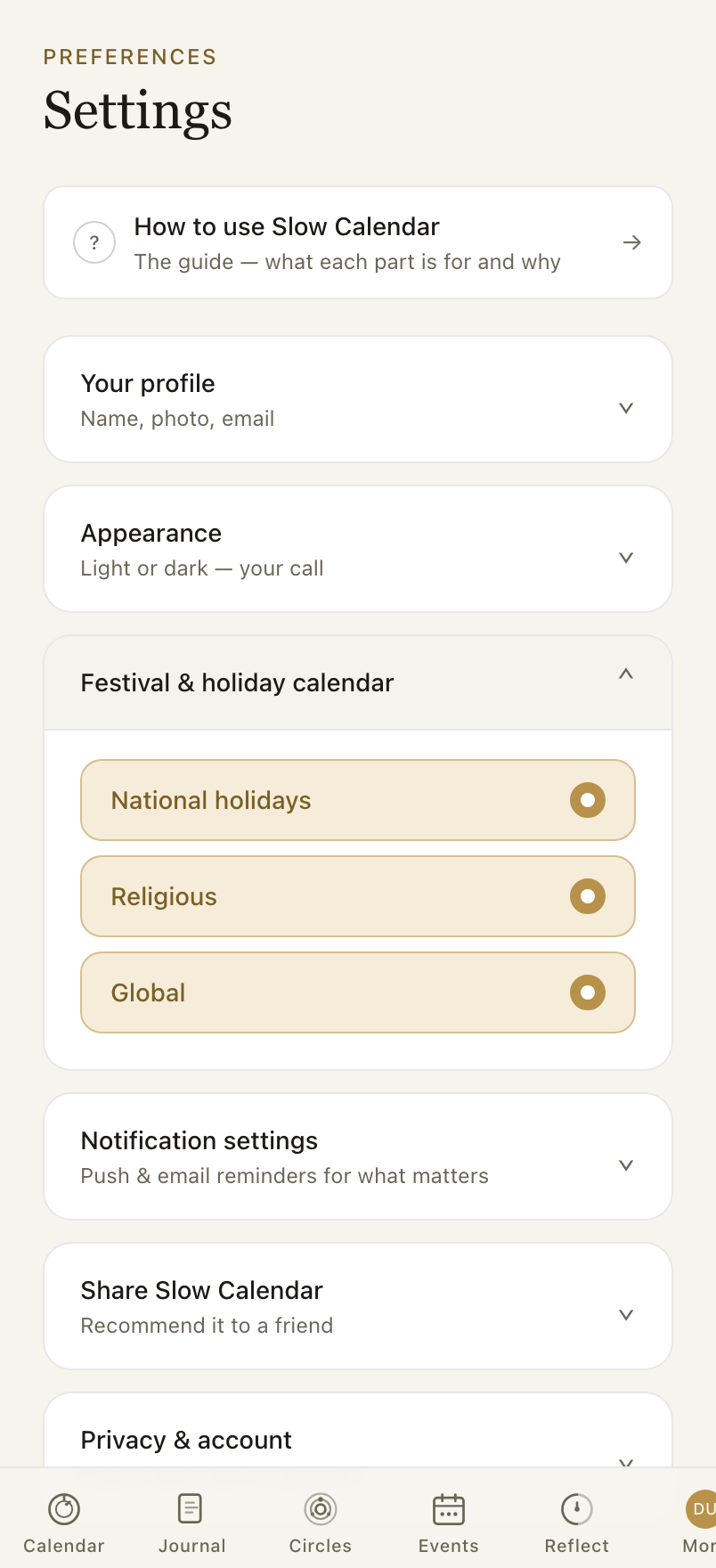
Your country sets the national and religious holidays that appear on the calendar. Toggle national, religious and global sets independently — keep what's meaningful, hide the rest.

Pick which holiday sets show on your calendar.

Notifications — quiet, not noisy

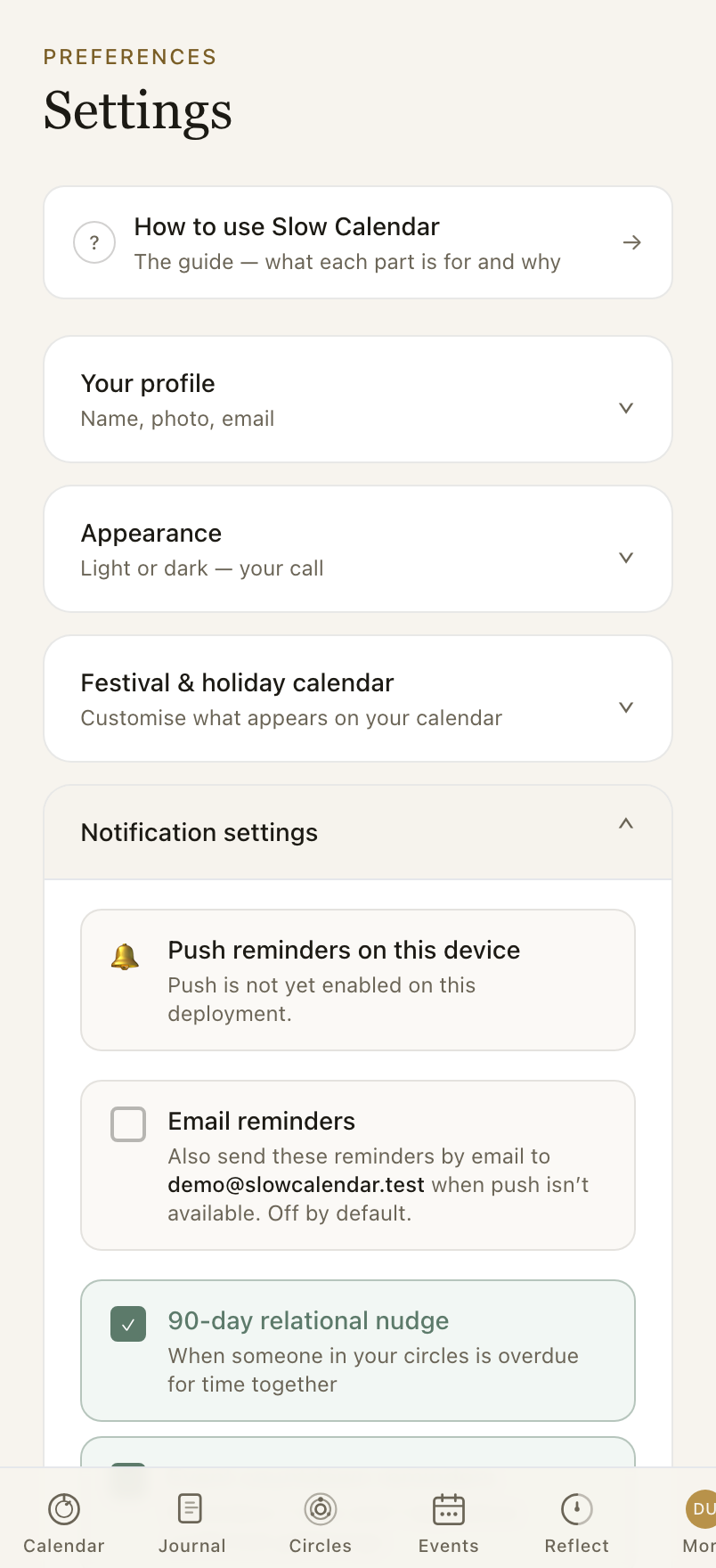
Turn on push reminders for the things that matter: a relationship going overdue, a gathering coming up, a birthday or anniversary. Email is opt-in for when push isn't available. No streaks nagging you, no spam.

Push and email reminders — each one optional.

Dark mode

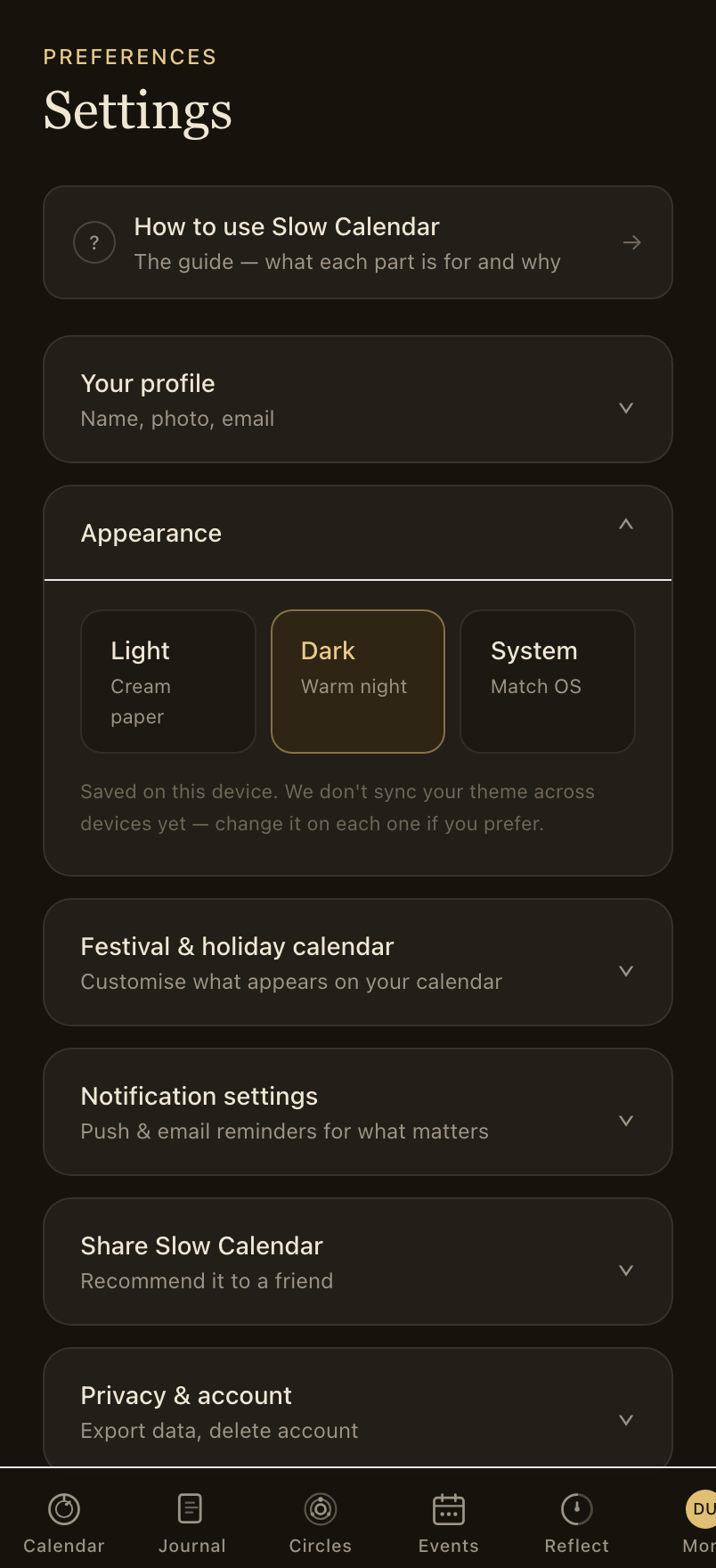
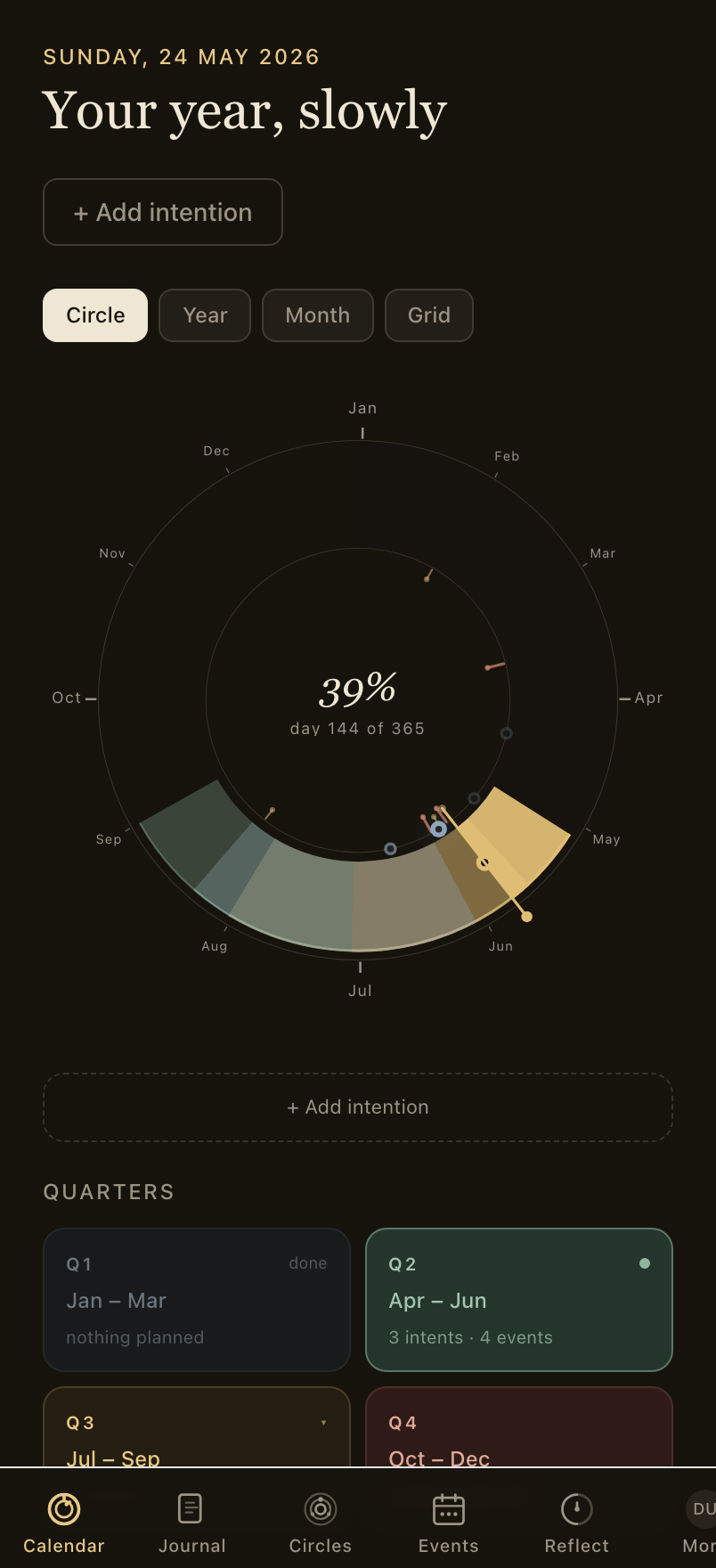
Choose Light, Dark, or System to follow your device. Dark is a warm night palette, not a cold black — the same calm calendar, after sundown. It's saved per device.

Appearance — Light, Dark, or match your OS.
The Year Circle in dark mode.

Share it

If it's helped you, pass it on. Sharing sends a friend a link with a short note — no account needed to take a look.

Recommend Slow Calendar to someone.

Why this exists

The founder's story

In 2025, I happened to travel to my native, and my elder niece's birthday fell on the same weekend. Nobody coordinated. Nobody checked in — as if expecting that was too much to ask. I felt strange. Let down. Then I looked back and realised I was part of the problem too.

I have two brothers. We scattered in different directions of the world for education and work. I told myself the sacrifice was necessary — stabilise first, reconnect later. But slowly, without anyone deciding it, the gap became permanent. We stopped meeting unless a big family event forced us together.

The gap stretched into the next generation. My kids and their cousins grew up in the same family but in different worlds — strangers who share a surname. Nobody chose that. Nobody prevented it either.

I journalled about it. I read everything I could find. I worked through the Upanishads — their insistence that a life well-lived is one turned inward with intention, not outward with busyness. I read Ryan Holiday's books on Stoicism — The Obstacle Is The Way, The Daily Stoic. Something in both traditions kept pointing at the same thing: the problem isn't how you spend your hours, it's whether you're spending them on what matters.

And I realised I had been treating the people I love like they'd always be there — like time with them was a default, not a choice I had to make.

It resonated deeply — and I thought about bringing together my journalling habit with the idea of designing intentional moments across the year. I wanted to keep the must-have moments on paper, so I could be prepared and looking forward to them. Never to miss the rhythm with my kids, my wife, my parents, my siblings, my colleagues, and the friends that matter.

So I built Slow Calendar around a framework I developed — I-ARC. Intent, Act, Reflect, Calibrate. Four steps that close the loop between who you want to be and how you actually live.

Have you ever felt you could have come together as a family more certainly in a year — and not left it to chance? Have you ever reached December wondering where the year went and who you missed along the way? I built Slow Calendar so neither of us has to ask that question again.

N

Naveen Alle

Founder, Slow Calendar

Now you know what it's for.

Open the app and begin.

Open Slow Calendar

Slow Calendar · Live your arc.